
SOME "BEFORE AND AFTER" PICTURES
OF OUR NEW HOME IN SCOTLAND
On the left is how the steading was when we bought it (the house was fine).
On the right is how it was 18 months later - though improvements continue!
SOME "BEFORE AND AFTER" PICTURES
OF OUR
NEW HOME IN SCOTLAND
On the left is how the steading was when we bought
it (the house was fine).
On the right is how it was 18 months later - though
improvements continue!
 |
 |
On the left is the courtyard as we found it - still with the cattle-handling facilities which were later removed leaving large holes in the ground! You can see the original farmhouse on the left, and the original byre centre and right. Doors have been added, as can be seen, the farmhouse has been lowered and re-roofed. (And painted).
 |
 |
On the left is the old farmhouse, and an old roofless building, full of junk, that used to be the dairyman's cottage. The courtyard in the previous view is over the roofs. On the right is the latest view, with windows, new roof and walls painted.
 |
 |
The left view is of the lovely old water mill which was driven by a wheel on the left behind the tin you can see there. A hole was made for some reason which we had made into a window, and the wilderness this side of it is becoming a paddock for the sheep which now do their lambing in the mill (when they have a problem). We also had the mill roof painted.
 |
 |
Here you see the entrance to the courtyard, as it was, and as it is now (Feb. 06). The old and very leaky tin-roofed shed has been demolished (much of the timber made a useful loft in the mill), the outer half of the double byre removed leaving an open shed used for a tractor and machinery. Front left shows the repair to the roof of the old stable, now a calf shed.
 |
 |
On the left is the old tractor shed. The tractor couldn't get in it, but an oil drum was kept there for re-filling it with fuel, and maybe even oil at times? Lots of other rubbish was found, too, like plastic bags, old tractor spares (used oil filters) etc. We cleaned it all out, nearly a trailer load of muck, and made a chicken run of it, buying for the birds a B&Q shed which you can see top left. The hens are Welsomer variety. The old iron frame was ideal for fixing the netting on to.
 |
 |
This view shows the scene from just inside the courtyard entrance, at the entrance to the old tin-roofed shed. There were gates (these nearly all disappeared when the farmer moved out) and the wall on the right has been demolished to leave the single byre, now the tractor shed. Part of the tractor shed was demolished, too, because the corner where that abutted the mill (see later image) was a leaky, rotting mess. This was due to a valley roof and a gutter that had been leaking for twenty years without any attention. The roof was removed, and the RSJ's used for a lintel for the doorway for roofless ruin opposite, now the entrance for our cars.
 |
 |
The old silage clamp was used for scrap plastic, tin sheeting, old motors, tyres, iron, wood, anything really that was past its sell-by! We sold over 10 tons of it as scrap. Now the remaining rubbish has been buried at the back, and the left clamp wall removed to the concrete by a digger, for use elsewhere. The concrete area has been kept for a useful feeding area for sheep in winter. The clamp wall on the right has been retained for shelter for sheep in winter.
 |
 |
This shows the main drive looking towards the road from half way up, by the entrance to the courtyard. As you can see, the roofless ruin has been roofed (no mean feat, as a reinforced concrete foundation ring had to be placed around the entire eaves level of the building). The garden wall has been cleaned of Ivy and painted, the barrels of Molasses have been removed (dumped by the farmer in the field he owns out of the picture on the left) and much rubbish removed also. The calf-shed is getting a new roof on this outer side, but has not been done yet. The lake you can see in the field opposite is now a memory, as the drainage has been sorted and the excess rain water now runs into the council drain along the road, and not into our neighbour's field.
 |
 |
Just inside the courtyard, you turn left to access the calf shed. (Formerly the stable). It has been cleaned up, repaired, painted and some tin sheeting on the roof replaced. The "roofless ruin" in front has been sorted, roofed, cleaned out of about two feet thick of rubbish after the old tin, bikes, mowers, sprayers etc. had been removed, and now houses cars.
 |
 |
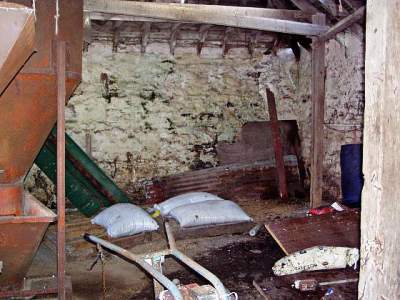
Inside the calf shed used to be a roller mill, and feed mixer, disused and rusty and we were not able to call this our own until three months after the move, when the farmer finally moved out. It now houses some calves belonging to a neighbour, and the necessary straw and hay for them. Temporarily, our car trailer lives there as well.
 |
 |
The old water mill. The small window in the lower centre of the left picture will be seen on the left in the right-hand picture. A loft made from the old tin shed in the courtyard, a redundant stairway from a demolition project nearby, some floorboards from the sheep-owner's cottage (being renovated) and some of his gates, and - presto! A lambing shed, open and well-ventilated with room for at least eight ewes with their lambs. The sheep belong to Neil Douglas, son of John at the Smithy across the road. It was thanks to Neil that my mad idea of using the mill for lambing became a reality, and he put in hour after hour to make it happen. Now we have a regular system of bringing in the ewes for lambing if we can, keep an eye on them for 24 hours, and out in the field if they are OK. The eight ewes can be pushed to eleven if necessary, with a pen upstairs for any orphans. It lacks a water supply, but that is for next year . . .
 |
 |
This is the end of the Calf Shed, bashed in by something before our time, and mended by the "Charlies" who have done most of our construction work. Photo. by Charles Davies.
 |
 |
This is the North end of the double byre, now a single byre turned tractor shed. We got the "Charlies" to mend the roof above the door, merge the byre roof into the "Woodshed" roof where the old byre extention was removed, and place a door there, recovered from the front of the double byre. They put a small "pop-hole" door in for future use with hens. The door is now standard red, with white-washed walls. Photo. by Charles Davies, builder modelled by Charles Winfield.
 |
 |
This one is put in to show how Charley Winfield loves to get in the picture! Actually, it is to show the awful condition of the old farmhouse, and the Dairyman's Cottage beside it, before the Charlies and I got going on it. I did the demolition and carried away the junk, they did the skilled bit. And did it well. Left-hand photo. by Charles Davies.
 |
 |
These pictures show the amazing difference in what was the "Dairyman's Cottage" and now is the Garage. The old kitchen range is still there, though sadly rusted and broken, and a doorway leads into the old sitting room which had a second floor at one time, and now houses a museum of relics dug out of the junk on the floor. Left hand photo by Charles Davies, taken after a lot of clearing out had been done, and ring-beam commenced to hold in the walls and make a firm wall-plate. More on this building, here.
 |
 |
The house has not changed very much - it was very nice
and full of character which was why we bought it. Needing to be painted,
though, we chose dark grey and white rather than the former black and white,
and we very quickly stripped Ivy from the walls, which was already damaging the
roof area. The rose garden was resurrected by my wife, too. It was there, but
covered in weeds, and when removed we found some very nice roses - some quite
elderly but flowering well.